


Bongolistically,
Mallam O.
A few days ago, I shared a story about my late father’s vision for my future. It was a walk to the family farm in Warima, during which I sensed that his thoughts had travelled far beyond the footpath we were following. He did not live long afterwards, leaving me to spend a lifetime wondering what he had hoped for me and whether I eventually became the man he wanted me to be.
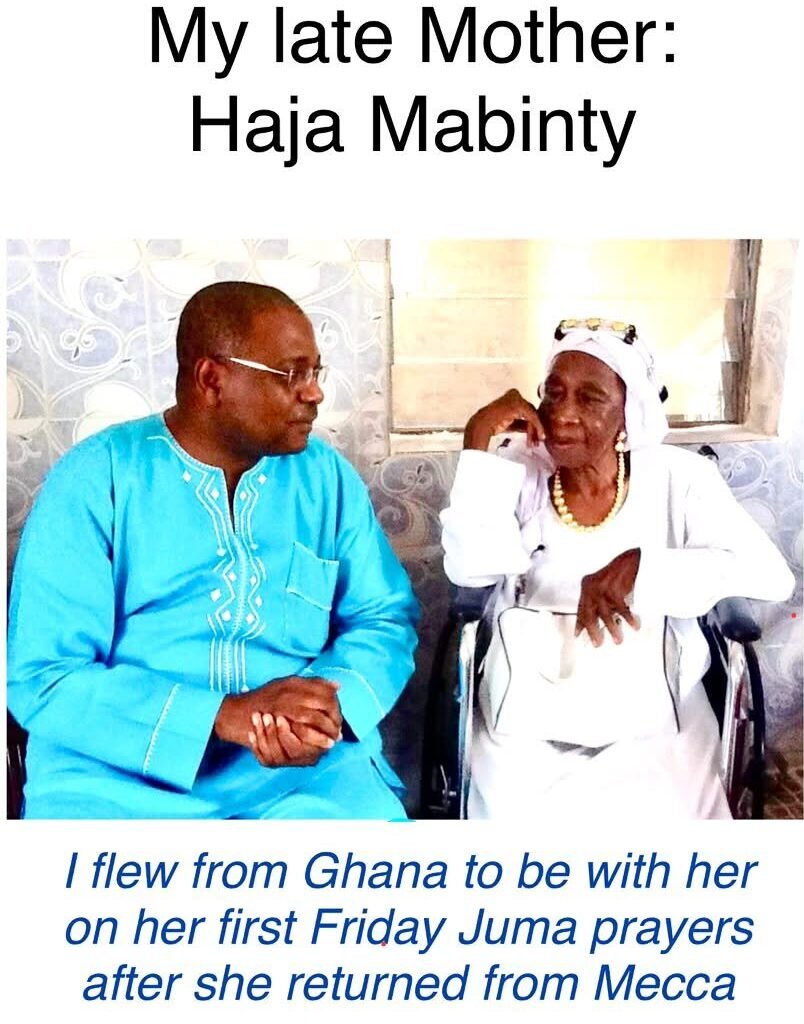
Today, I turn to my late mother’s vision.
As I began writing, I realised that I was just as curious as my readers may be. Would a mother’s hopes for her child be different from a father’s? Does a mother dream differently? Or are the aspirations of both parents simply two expressions of the same love?
I do not know the answer.
All I have are memories.
So, once again, I return to Warima, to another afternoon from my childhood, to listen to the hopes of a parent who, in her own way, was also looking into the future.
—
School would be over, and I would hurry home, toss my books inside the house, and go looking for Ya Mabinty, my mother.
On the few occasions she decided to prepare a meal for us, since there were several other relatives who helped with that chore, she would be outside. I would simply sit beside her. It was enough just being there.
Member was almost always with us. Looking back, I am glad he was called Member, because that is exactly what he was. He was not our dog; he was one of us. He helped to raise me. It still amazes me when I think about it.
One afternoon, just before I was due to leave Warima for Tomlinson High School in Songo, I noticed my mother staring into space. She had put eggs on the fire to boil, but her thoughts had taken her somewhere else. The water had almost boiled away.
Then Member gave one of his long yawns. Not an ordinary yawn. It was almost as if he was saying, “Ya Mabinty, remember the fire.”
My mother turned quickly. “Oh, thank God,” she laughed. “It’s only eggs. The worst that can happen is that they become harder than they should.” She rubbed Member gently on the head. His tail began wagging immediately, as if he knew he had done something worthwhile. I remember smiling to myself. I was convinced they understood each other.
We settled down again. After a while she spoke, almost as though she had forgotten I was there.
“I can’t wait for the day when I shall be playing here with my first grandchild.” She smiled as she spoke. “I shall give him or her all the love I have given you.”
I laughed. ”Mama, that will be a long long time from now.”
She looked at me.
“I am only going to secondary school. After that comes college. And you know Papa has already decided that I shall study in England. He tells everyone in the village.”
I remembered hearing him only the day before at the market while buying bananas. He was telling anyone who cared to listen that his son would one day study in England.
She nodded. “That is good. Go and learn. Then come back. There will still be work to do here.”
Then, after a short pause, she smiled again.
“Who knows? You may even become President.” To her, it was not an impossible dream.
The late President Siaka Stevens of Sierra Leone used to stop in Warima to visit my father. They were good friends from my father’s days in Panguma in Eastern Sierra Leone. Whenever he came, he never behaved as though he was above everyone else.
One visit has stayed with me. We were all eating together from the same tray. As we ate, I noticed the President taking pieces of meat from his own portion and placing them in front of my younger brother. As a little boy, I came to the only conclusion my mind could reach. “Perhaps Presidents don’t eat much meat.” Only years later did I understand. It was generosity. He had seen a child and simply wanted the child to enjoy the best pieces.
Today, when I think back to that afternoon with my mother, I find myself asking questions she can no longer answer.
Did she know how many years would pass before she held her first grandchild? Did she imagine that my journey would take me far beyond Warima, to places she would never see? Did she ever picture the life I eventually lived?
Unlike my father, she lived very long enough to watch that journey unfold. She saw me complete my doctoral education. She watched me begin my professional life in Germany as a scientist at the University of Heidelberg. Later, she knew that her son was leading an international organisation from Ghana. Each time I returned home, she listened to my stories with the same interest she had shown when I came home from primary and secondary schools and sat beside her while she prepared the evening meal.
One of the greatest joys of my life was being able to give something back to her. The old house in Warima, where she had raised us, gave way to a modern ‘upgaret’ home. It became a source of pride not only for her but for the village. Visitors admired it, but I admired something else: seeing my mother move around it with the contentment of someone who never expected life to reward her in such a way.
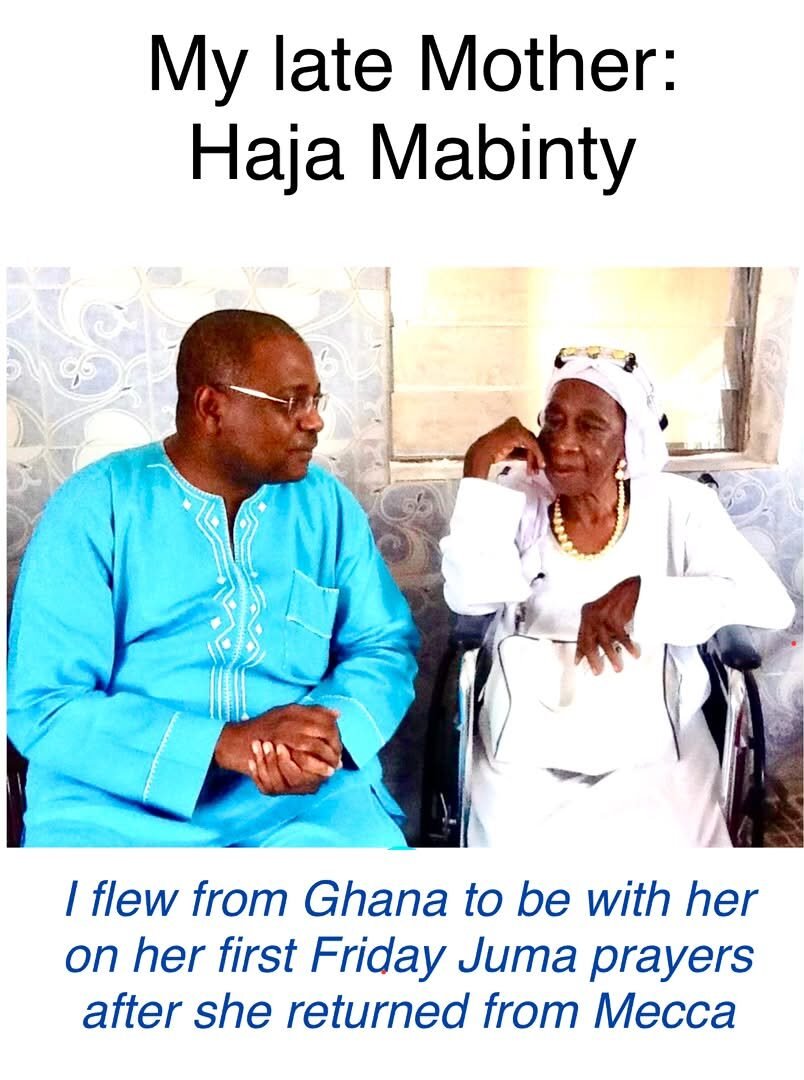
I was also able to fulfil another of her deepest wishes. Like most Muslims, she longed to perform the pilgrimage to Mecca. By the grace of God, I was able to send her. When she returned as a Haja—as seen above, there was a new sense of peace about her. It was as though one of the prayers she had carried throughout her life had finally been answered.
She spent her final years in that house. When her time came, she was laid to rest beside my father in the soil of Warima, where their journey together had begun many decades earlier. From time to time, I find myself wondering why mothers seem to outlive fathers so often. Perhaps it is only my own experience speaking, but it is a thought that has stayed with me.
Today, when I remember my mother’s words, “I can’t wait for the day when I shall be playing here with my first grandchild”, I realise that God granted her far more than that. She lived to see her son educated. She lived to see him serve beyond the borders of Sierra Leone. She lived to see him return to Warima, not as the little boy who once sat beside her, but as a man able to honour the sacrifices she and my father had made.
Whenever I visit their graves, lying side by side beneath the soil of Warima, I think back to those afternoons with Member stretched at our feet and eggs boiling on the fire.
My father’s dreams became questions I can never ask him. My mother’s dreams became blessings she lived to see with her own eyes. For that, I shall always be grateful.
Mallam O.