

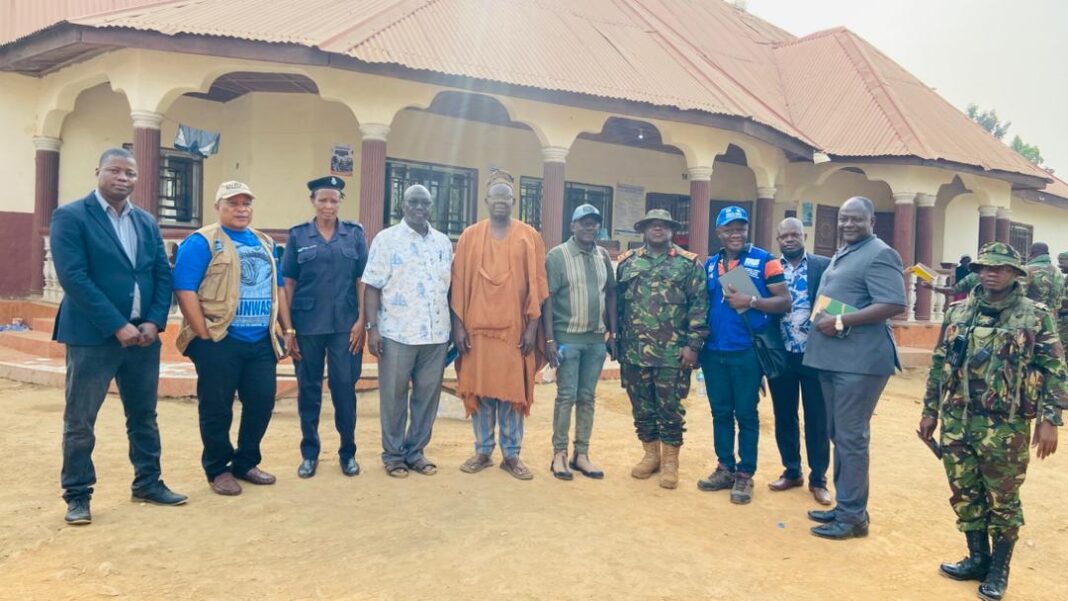

By Yeabu Bangura
A government fact-finding mission has reported longstanding tensions and intimidation along the Sierra Leone–Guinea border following a February standoff in the town of Kaliyereh in Falaba District that led to the arrest of 16 Sierra Leonean security personnel by Guinean forces.
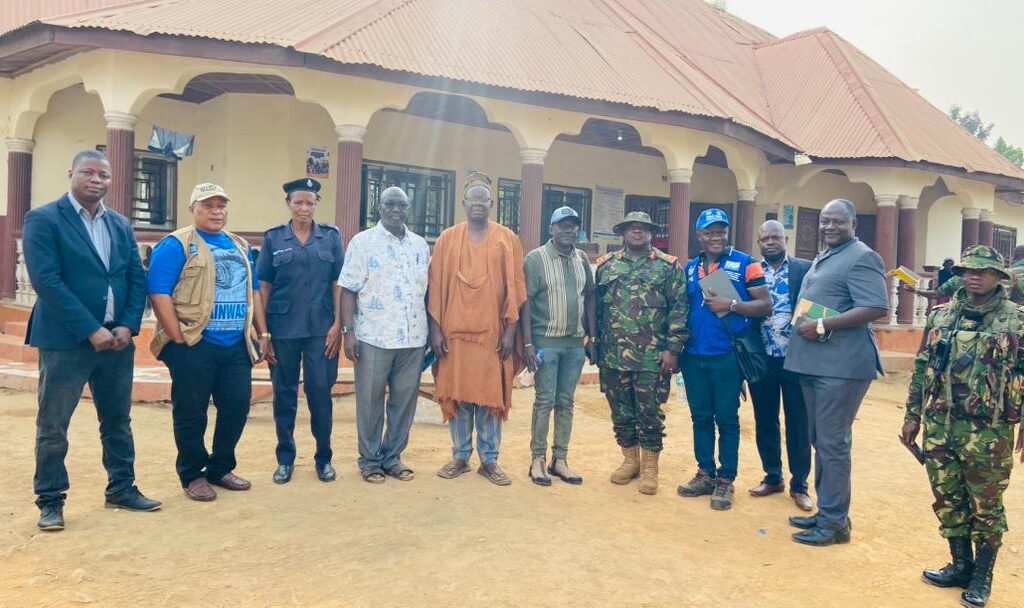
The report, released after a multi-agency delegation visited the area, said residents of Kaliyereh and surrounding border communities had for years complained of harassment, extortion and intimidation by members of the Guinean Armed Forces (GAF) and groups of Guinean youths.
According to the findings, locals alleged that Guinean personnel had demanded taxes on farming activities across the border, frequently accused Sierra Leoneans of theft, and contributed to the breakdown of cross-border marriages.
The eight-member delegation was constituted following a directive issued by Sierra Leone’s vice president on Feb. 24, a day after the incident in which Guinean troops reportedly detained 14 members of the Republic of Sierra Leone Armed Forces (RSLAF) and two Sierra Leone Police (SLP) officers.
The team included senior officials from the Office of National Security, the RSLAF, the Ministry of Local Government and Community Affairs, the Ministry of Finance and International Cooperation, the Criminal Investigation Department, Statistics Sierra Leone and other national institutions.
It was tasked with determining the territorial status of the disputed location in Kaliyereh, verifying the sequence of events that led to the confrontation, confirming the status of the detained personnel and assessing the wider security and diplomatic implications.
The delegation arrived in the area on Feb. 26 and held meetings with local authorities, including Paramount Chief Dr. Manga Salifu Salito Samura IV of Solema Chiefdom and Paramount Chief Manga Sorie Konko Jawara II of neighbouring Dembelia Musaia Chiefdom.
According to the report, the standoff occurred when a joint team of RSLAF and SLP officers was making bricks to construct accommodation for security personnel stationed at the border in what they believed to be Sierra Leonean territory.
Guinean soldiers then crossed into the area, halted the construction, removed the Sierra Leone national flag and asserted that the land belonged to Guinea, the report said.
Guinean troops initially withdrew after attempting to stop the work but later returned the same day with about 300 heavily armed personnel, including machine guns, anti-aircraft weapons mounted on pickup trucks and armoured vehicles, the report added.
Sierra Leonean personnel did not open fire, following strict orders and de-escalation efforts led by their commanding officer, Captain Francis Conteh, the report said. Guinean forces subsequently detained the 16 officers, seized their weapons and took them across the border into Guinea.
The incident drew high-level attention from the Sierra Leone government, which said it was concerned about national sovereignty, territorial integrity and the welfare of the detained personnel.
Investigators also used geospatial technology and interviewed community stakeholders during their inquiry. They found that the land where the construction was taking place had been allocated to the security forces by Kaliyereh town chief Manga Samura.
The delegation said it could not directly engage Guinean authorities during its investigation. However, Lieutenant Colonel Saidu Kuyateh, commanding officer of the 12 Infantry Battalion, told the team he had contacted Conteh through WhatsApp video calls while he was in detention.
During one call, the detained officer reported that the arrested personnel were being held in an open hall and were lying on a bare floor.
All 16 security personnel were later released and have since returned safely to Sierra Leone, the report said.
The investigation also highlighted deeper socio-economic challenges in the border area, noting that economic activities in Kaliyereh are heavily dependent on Guinea and that most transactions are conducted in Guinean currency.
The report cited a limited presence of Sierra Leone government institutions, poor road infrastructure, unemployment and a lack of basic social amenities. It also said the suspension of the local cross-border market, known as the “Luma,” had worsened livelihood challenges.
The delegation warned that unclear border demarcation and limited state presence were contributing to recurring tensions and operational uncertainty.
It also noted that Guinean troops remained heavily deployed in the contested area, preventing Sierra Leonean residents from accessing the land.
Despite the confrontation, the report commended Sierra Leone’s security forces for showing restraint to avoid escalation.
Among its recommendations, the delegation called for formal recognition of the detained personnel for their professionalism, the permanent demarcation of Sierra Leone’s borders, and stronger government presence in disputed areas.
It also urged improvements to road networks, increased security deployment with better equipment and accommodation, and the strengthening of the technical committee responsible for border issues.
The report further recommended engaging regional organisations such as the Yalunka Organization and international partners, including the International Organization for Migration, to support mediation and community development.
The delegation said implementing the recommendations could help resolve long-standing border disputes and prevent future confrontations.