


Long before I ever stood before him in a courtroom, I knew Justice Stronge as a presence to be respected from a careful distance. As a pupil at Fourah Bay College Primary School, I would, together with other students, call upon my classmate Cordelia (May) at the family home on Wellington Street, where his chambers occupied the adjoining property. We were invariably counselled, in our own best interest, to be on our very best behaviour. On the few occasions I caught sight of him, he appeared every inch the thorough disciplinarian, immaculately suited, moving with a quiet yet unmistakable authority. In our class, he was reckoned the second strictest father among them, after only the father of another classmate, Solomon Juxon-Smith, the late Colonel Andrew Juxon-Smith.
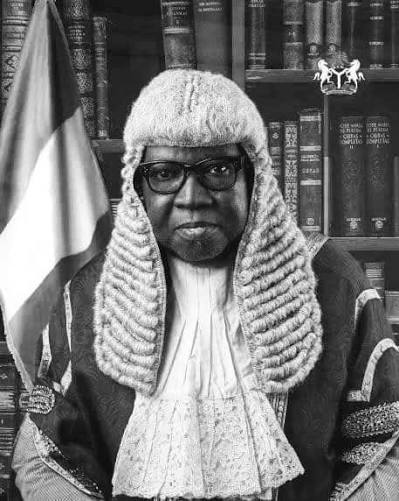
Born in Freetown in 1939 with great-great-grandparents from Jjekeja in Aku Country, he was a son of the CMS Grammar School, where he rose to become Prefect and Head Boy before proceeding to Fourah Bay College. The wider nation would come to know him in his later years as Speaker of the Parliament of Sierra Leone, an office he held with distinction from 2007 until his retirement from the chair. He succeeded Edmond Kadoni Cowan and was returned unopposed in 2012. He brought to that high office the same insistence on procedure, order and plain truthfulness that had characterised his years on the bench. So evident was this quality that even the Sierra Leone Association of Journalists (SLAJ) saw it fit to commend him publicly for his steadfast defence of accuracy and a free press.
Yet those of us who practised before him knew him first, and knew him best, in his robes. He possessed a rare devotion to timeliness. As an advocate and later as a judge, ANB Stronge was never late, and he expected nothing less of those who appeared before him. With him, an 8:45 am listing meant precisely 8:45 am and not a minute later. Judge’s summonses were disposed of promptly in chambers, and applications for interlocutory relief, injunctions and the like were dealt with the moment counsel had concluded their submissions. He would take a brief stand down to frame his order in the clearest possible terms and return with a ruling so lucid that the subsequent drawing up became the simplest of tasks.
Similarly, he didn’t joke with his costs. No sooner had I filed a Notice of Change of Solicitors, taking over a matter from the late Riby Williams, than a letter arrived from him reminding me, in the plainest terms, that his costs remained outstanding and were to be settled by my clients without delay. It was a small thing, but it told me a great deal about the man, exacting with himself as much as with others, and prompt in all things, not least where his own fees were concerned
For all his sternness, he came down unfailingly on the side of justice. I appeared before him on many occasions, winning some matters and losing others, yet I always left his court without a single complaint. I cannot recall a single instance in which I felt compelled to appeal against any decision he delivered.
After the war, a dash card would circulate in his court, inviting contributions towards the rebuilding of Trinity Church, the church he held so dear. I contributed regularly and without hesitation, but it never once occurred to me that the card carried the slightest influence upon his judgements. It did not, and he ensured that it never would. The story is still told of a senior member of the Bar who, with an important application before the court, imagined that a handsome donation to the church might tilt the outcome in his favour. The application was refused nonetheless, and the learned gentleman was heard complaining bitterly outside the courtroom long afterwards.
He possessed, too, a mind entirely his own. He remains the only judge I ever saw refuse an application for a decree nisi in an undefended divorce, a thing almost unheard of, and a true measure of the seriousness with which he regarded the court’s duty to satisfy itself before granting any form of relief.
I had the singular, and faintly terrifying, privilege of cross-examining him not once but twice. On the first occasion he appeared against my client as plaintiff in person, seeking damages after my client’s driver was said to have struck the door of his vehicle. Within forty-eight hours of the accident, he had issued his writ of summons and gone, in person, to serve it upon my client at his office, to my client’s utter astonishment. I telephoned him the following day to explore a settlement, but his terms were stiff, and so to court we proceeded. He took the oath and gave his evidence. With barely five years at the Bar behind me, I rose to cross-examine him. I employed every device I had previously used to unsettle senior counsel. Even when I put it squarely to him that the accident was of his own making, for opening his door without due care, he maintained the straightest of faces and would concede not a shred of contributory negligence. The matter was eventually settled.
The second cross-examination proved the more daunting, for by then he was already a judge. The head of our chambers, the venerable Albert Llewelyn Olawole Metzger, was indisposed, and the Judge insisted I cross-examine in his stead. Even though our gracious client, the Respondent in the matter, had urged us to go easy on him, I felt the need to put him, the Petitioner, through his paces in the witness box. When the matter was decided against him, we filed a decree nisi, to which he promptly appealed. Whether that appeal was ever resolved, I cannot say, for he never once mentioned the matter to me outside of the courtroom.
After cross-examining him, I was obliged to appear before him in his court on another case that very same morning. He did not give the faintest indication that I had subjected him to a few uncomfortable minutes earlier the same day. He granted my order without the least fuss, as though nothing whatever had passed between us.
It was after that second encounter that I began to get a glimpse of the man behind the robes. One afternoon, while I was around Congo Cross, off the MGHS road, he spotted me from his verandah and called me up to join him over a few of our favourite beverages. As we spoke of the glory days of Sierra Leone and of its judiciary, he shared stories of judges I had known only by reputation, together with a good many lessons on life besides.
On that day, and on the several other occasions when I was summoned to his verandah, I came away with the firm impression that the learned trial judge was, beneath all his sternness, a most engaging and mischievous spirit. More than once, I caught him smiling quietly as he recounted the traps he had laid for counsel and watched them perspire. In short, beneath the robes, he was mischief wrapped in the finest of tailoring.
All who knew Justice Stronge well understood that he was fond of good company and of a good drink. It became a standing joke at the Bar that the most favourable season in which to appear before him was Lent. He loved to organise parties and gatherings, and he lived, by every measure, a full and generous life.
He once told me of a voyage by boat to The Gambia during the war, and from that conversation he gave me a line I have never since forgotten, “Circumstances may change, but standards must be maintained.” He lived by those words to the letter. However far the standards around him may have fallen over the years, Justice Stronge held fast to the very highest of his own, in the most challenging of circumstances, right to the end.
In his later years he withdrew gently from public life. Sierra Leone has now lost a stern judge, one of its finest legal minds and one of the truest characters ever to grace its Bar and its Bench. Certainly, he was one of the rare few Regentonians who qualified to be honoured with the title of Honorary Prince Walean.
May he rest in perfect peace.
Copied from Facebook