


By John Brima
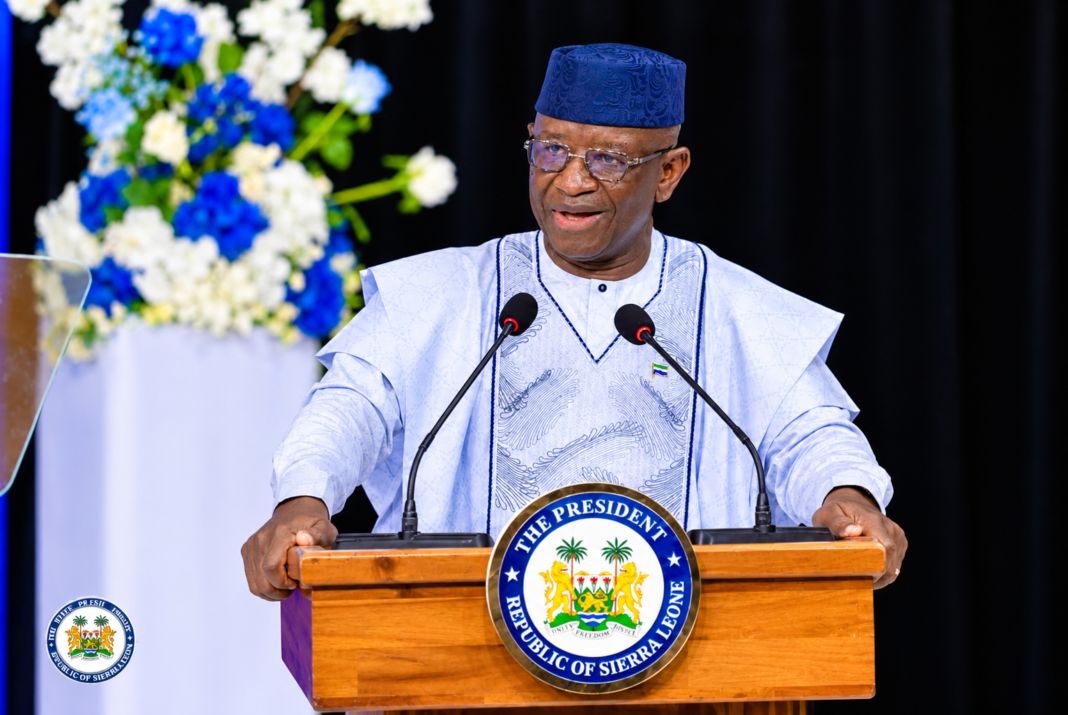
FREETOWN, October 28, 2026 — Sierra Leone President Julius Maada Bio apologised to civil war victims on Monday and announced plans to review reparations, publish a report on implementing reconciliation recommendations and establish a national peace memorial.
Speaking at the National Unity and Social Cohesion Conference in Freetown, Bio called for greater national unity, accountability and inclusion, saying the country must move beyond preserving peace to improving the lives of its citizens.
“On behalf of the State of Sierra Leone, I apologise for the suffering you endured and for the protection you did not receive. I am SORRY,” Bio said.
He directed the National Commission for Social Action and other relevant institutions to review and strengthen the reparations programme recommended by the Truth and Reconciliation Commission (TRC). He also called for a public report on the implementation of the commission’s recommendations by January 18, 2027.
The president urged the Ministry of Health to work with the Peace Commission and faith communities to expand mental-health and psychosocial support for people still affected by the 1991-2002 civil war.
The conflict killed tens of thousands of people, displaced millions and left deep social and economic divisions. A 2002 declaration marked its official end, but questions surrounding justice, reparations and the implementation of reconciliation recommendations have remained part of the country’s peacebuilding agenda.
Bio said the conflict had been fuelled by longstanding grievances, exclusion, injustice, abuse of authority and unequal access to opportunities. He acknowledged that the state had failed to protect citizens from the suffering that followed.
He also recognised the role of successive governments, women’s organisations, religious leaders, civil society, the media and local communities in maintaining peace.
“Peace must become part of our national culture. It must be visible in the laws we uphold, the institutions people trust, and how we treat one another,” he said.
Bio reaffirmed his commitment to a peaceful transfer of power after the 2028 presidential election, saying he would complete his constitutional mandate and hand over the presidency to the candidate chosen by voters.
“Let me state this without qualification; I will not be a candidate in the 2028 Presidential Election,” he said.
The president also proposed a national peace and cohesion action framework, a fund to support community peacebuilding and remembrance, a strengthened inter-party dialogue committee and a code of conduct for peaceful elections that registered political parties would be encouraged to sign before the 2028 polls.
Other proposals included peace and civic education in schools, a national peace week culminating on January 18, 2027, and the commencement of work on a national peace memorial.
Former President Ernest Bai Koroma, who attended the conference, called for greater national ownership of peacebuilding and urged Sierra Leoneans to address unresolved challenges through open dialogue.
Koroma thanked Bio for facilitating his return to Sierra Leone and acknowledged his contribution to the country’s peacebuilding efforts, including the establishment of the Peace Commission. He also offered to draw on his experience to support national reconciliation.
Representatives of the United Nations, the Economic Community of West African States, the diplomatic community and other stakeholders also took part in discussions on political dialogue, national unity and social cohesion.
The conference, held under the theme “From Agreement to Action: Strengthening Unity, Advancing Social Cohesion, and Building a More Peaceful Sierra Leone through Conflict Prevention”, focused on identifying practical measures to address unresolved grievances and strengthen public trust.
Bio said his administration would work towards a country where families could afford food, children could access education, health facilities could care for the sick and young people could find meaningful employment.
“For as long as I remain in office, I will work for a Sierra Leone where families can put food on the table, children can learn, clinics can care for the sick, and young people can find meaningful work,” he said.
The proposed reparations review and publication of the TRC implementation report will provide opportunities to assess progress on the recommendations and identify outstanding commitments. The government has yet to provide details of the proposed peace memorial, its funding or the timeline for its construction.