

FREETOWN, Aug. 19 2026 – Sierra Leone’s Ministry of Health has started local production of essential infection prevention and control supplies for government hospitals and health facilities nationwide, as the country seeks to reduce preventable infections and sepsis-related maternal and child deaths amid persistent challenges in its health system.
The initiative is being implemented through the ministry’s National Infection Prevention and Control (IPC) Programme and forms part of the government’s 300 Days of Activism for Triple Zero campaign, which aims to reduce maternal deaths, child deaths and the number of zero-dose children.
Nanah Fofanah, Programme Manager of the National Infection Prevention and Control Programme, said infections remained a major contributor to maternal and child deaths, particularly when they developed into sepsis.
She said strengthening infection prevention practices in healthcare facilities was critical to preventing avoidable infections and saving lives.
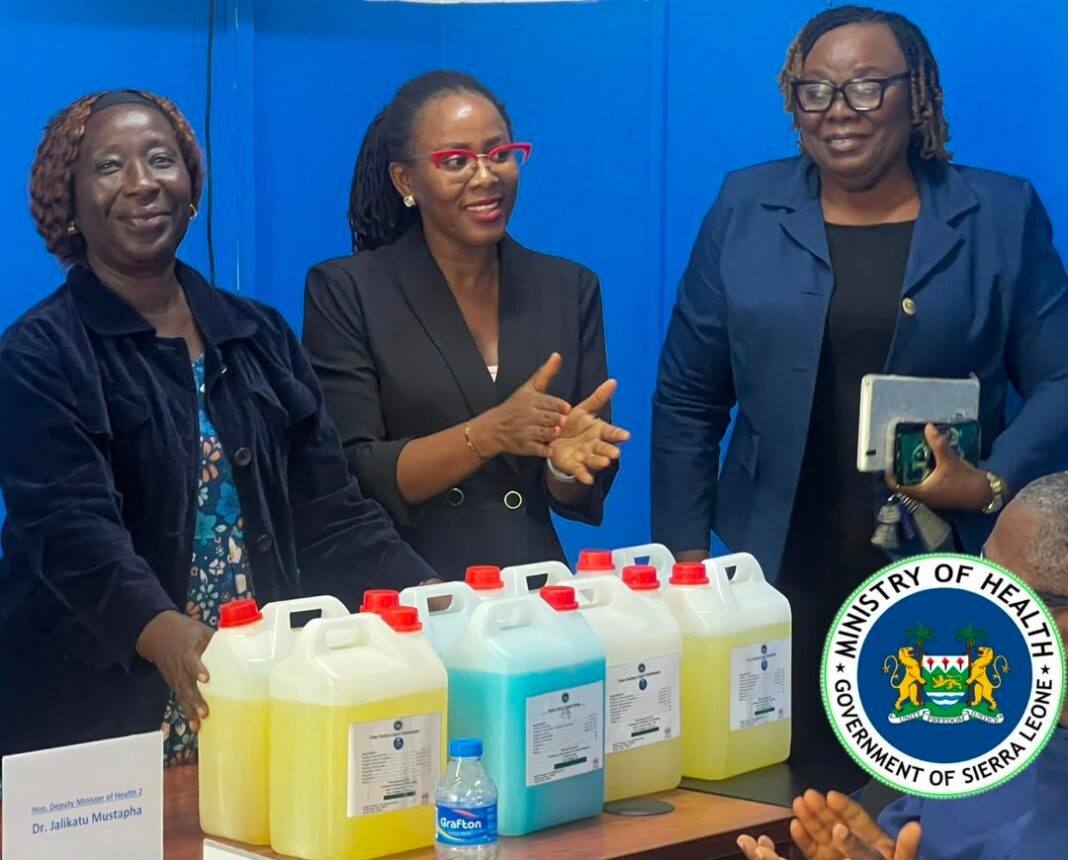
The first locally produced supplies include liquid soap, hand sanitiser and liquid detergent. Liquid soap will support regular handwashing, hand sanitiser will be available for healthcare workers and patients, while liquid detergent will be used to clean healthcare environments, surfaces and medical equipment.
The initiative comes against the backdrop of a health sector that continues to face major pressures in a country classified by the World Health Organization as a low-income country. WHO data show Sierra Leone’s health system continues to carry a heavy burden of infectious diseases and premature mortality, while the quality of national mortality data remains limited.
Sierra Leone has made significant progress in reducing maternal mortality, but the level remains high by international standards. WHO reported that the country’s maternal mortality ratio fell from 1,682 deaths per 100,000 live births in 2000 to about 443 in 2020.That progress has not eliminated the risk of women and children dying from conditions that can be prevented or treated when medical care is available quickly. UNFPA says many maternal deaths in Sierra Leone are preventable and continues to support the government in strengthening health workers, facilities and monitoring systems.
For poor families, the consequences of weaknesses in the health system can be particularly severe. A relatively straightforward illness can become life-threatening when treatment is delayed, medicines are unavailable, diagnostic services are limited or patients arrive at health facilities after their condition has deteriorated.
Malaria, infections and other common illnesses continue to place a heavy burden on the country’s health system. Research has found that malaria accounts for a substantial share of childhood deaths in Sierra Leone and that many malaria deaths were considered preventable.
The country’s economic difficulties can compound those pressures. Sierra Leone’s health system operates in a low-income setting where families and health facilities face constraints in accessing medicines, equipment, trained personnel and other essential resources.
In such an environment, prevention can be as important as treatment. Ensuring that hospitals have adequate supplies of soap, sanitiser and cleaning products can help reduce the transmission of infections and protect patients whose health is already compromised.Healthcare-associated infections can be particularly dangerous for pregnant women, newborns, children and patients undergoing surgery or treatment for other illnesses. When infections progress to sepsis, the consequences can be rapid and potentially fatal.
The local production initiative is therefore intended to address a basic but critical part of healthcare delivery.
By producing the supplies locally, the government also hopes to strengthen domestic capacity and reduce dependence on imported infection prevention products. Reliable supplies are essential if health workers are expected to maintain proper hygiene standards across hospitals, clinics and community health facilities.
The ministry did not disclose the production capacity of the initiative, the number of facilities covered by the initial rollout or the cost of manufacturing the supplies.
It also did not say whether local production would eventually be expanded to include other medical and infection prevention commodities.
The scale of Sierra Leone’s health challenges means that such an initiative alone cannot resolve the wider problems confronting the sector. Improvements in hospital infrastructure, staffing, diagnostic capacity, emergency care, access to medicines and reliable funding will also be necessary to reduce preventable deaths.
Recent research continues to identify disparities in access to maternal healthcare, particularly between different parts of the country. A 2026 study found that despite progress in reducing maternal mortality, significant disparities in the delivery and use of maternal health services remain.
The government has nevertheless made reducing preventable maternal and child deaths a central priority through the 300 Days of Activism for Triple Zero. The campaign describes preventable maternal and child deaths as a major public health challenge requiring intensified action.
The local production of infection-control supplies adds a practical element to that campaign by focusing on one of the most basic requirements for safe healthcare.
For ordinary Sierra Leoneans, particularly those living on limited incomes and in communities far from major hospitals, the quality and availability of healthcare can mean the difference between a minor illness being treated successfully and becoming a medical emergency.
The ministry’s initiative is therefore likely to be judged not simply by the quantity of soap, sanitiser and detergent produced, but by whether those supplies consistently reach health facilities and contribute to safer care.
As the 300 Days of Activism continues, health authorities face the broader challenge of ensuring that Sierra Leone’s hard-won progress in maternal and child health translates into further reductions in deaths from preventable conditions.The government says infection prevention is a key part of that effort. But sustained investment across the wider health system will be required if people are to stop dying from illnesses that could have been prevented, diagnosed early or treated effectively.